
GST Register in India: Who Needs It, How to Apply, and What to Check Next
gst register is the search many Indian business owners use when they are trying to understand whether they need GST registration, how to get a GSTIN, which documents to keep ready, how the GST portal works, and what happens after registration. In practice, the search usually sits at the start of a longer compliance journey: choosing the right tax period, creating the correct GST payment challan when tax is due, filing the right return on time, and keeping proof that the numbers in books, returns, and ledgers match.
A first-time founder, freelancer, retailer, service provider, e-commerce seller, or small manufacturer often reaches this point because a customer asked for a GST invoice, the business is approaching a turnover threshold, or a bank, marketplace, or professional client wants a GSTIN before onboarding. Others search after hearing about GSTR-1, GSTR-3B, input tax credit, e-invoicing, or e-way bill requirements and want to know whether registration is the first step or just one part of the process.
This guide gives a practical answer-first explanation of GST registration in Indian context. It covers who needs to register, what thresholds and exceptions matter, the difference between regular and composition schemes, the core documents, the portal workflow, and what to check after the application is approved. It also explains how GST registration connects to return filing, payment, ledgers, invoicing, and reconciliation so the registration does not become a half-finished compliance exercise. Where the task becomes complex, WealthSure’s expert-assisted GST support can help with registration, filing, notice response, reconciliation, and related compliance work.
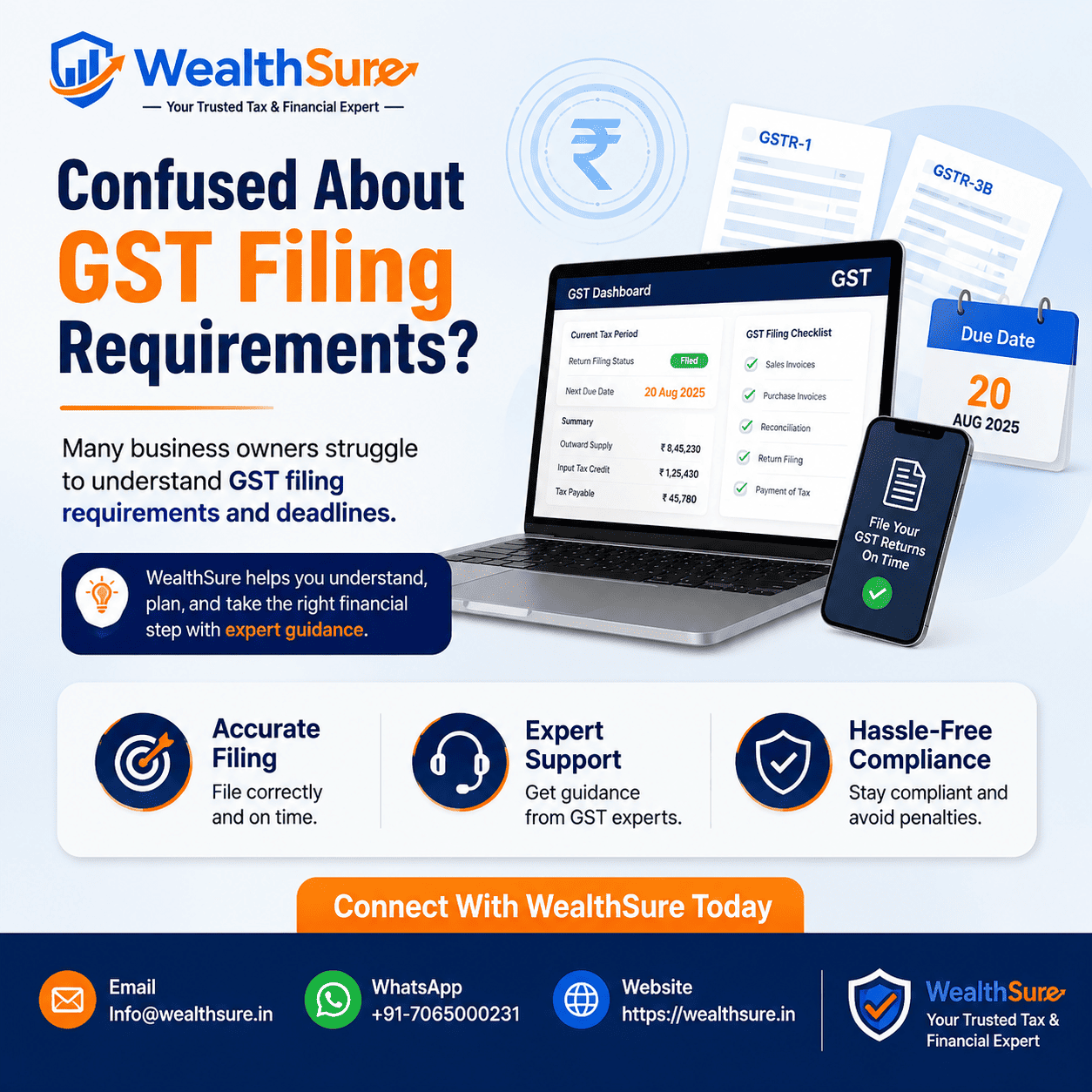
GST register means applying for GST registration and obtaining a GSTIN for a business that is required to register under GST law or wants voluntary registration. Once a business has a GSTIN, it can issue tax invoices, collect GST where applicable, and move into the regular compliance cycle of return filing and payment.
The right answer depends on what the business actually does. A small service provider may be below the threshold today and still need to register because of a compulsory category or a specific business arrangement. A trader may be over the threshold in one state but not another. A marketplace seller, inter-State supplier, e-commerce participant, or business dealing in notified supplies may need registration earlier than a casual reader expects.
That is why a good GST article should not stop at “register online.” It should also help you pick the correct business type, gather the right documents, understand the portal steps, and know what to do after approval. If you are also trying to understand GSTR-1, GSTR-3B, GST payment challans, electronic ledgers, or input tax credit, registration is the foundation, not the finish line.
Key Takeaways
- GST registration is the entry point to the GST system, but post-registration compliance still matters every month or quarter.
- Thresholds depend on whether the business supplies goods or services, the state or union territory, and any compulsory-registration rule that applies.
- A correct application needs matching PAN, business constitution proof, address proof, bank details, and authorised signatory information.
- After registration, businesses usually need to manage invoices, returns, tax payments, and ledger checks together.
- Composition scheme eligibility, e-invoicing, and e-way bill rules are separate decisions that should be checked after registration.
- Input tax credit works only when invoices, supplier compliance, and return matching support the claim.
- Expert help becomes useful when the business has multiple locations, mixed supplies, notices, refund issues, or reconciliation problems.
What This Page Covers
- What GST registration means in practical Indian business terms.
- Who needs GST registration and which thresholds or exceptions can trigger it.
- How CGST, SGST, IGST, and UTGST fit into the registration and tax-payment picture.
- Whether a regular scheme or composition scheme is more suitable for a small taxpayer.
- Which documents should be ready before applying on the GST portal.
- How to apply online and confirm that the GSTIN, ledger, and filing setup are working.
- What to check after approval so registration does not create avoidable compliance gaps.
Research Basis and Regulatory Context
This article is based on the GST portal workflow, CBIC FAQs, GST portal user manuals, GST payment and ledger guidance, and official e-way bill and e-invoice system pages. For the live registration journey, the GST portal help pages show the process for new registration, document checklist, and portal navigation; the portal content and rule references can change, so the official pages should be treated as the source of truth for the final application.
For current status checks and legal interpretation, the most important references are the GST portal, the CBIC GST FAQ page, the GST registration user guide, the electronic cash ledger guide, and the e-way bill FAQ page. These sources are better than informal blogs when you need to verify thresholds, payment steps, or filing behaviour.
WealthSure can assist with interpretation, registration, return filing, input tax credit reconciliation, e-invoicing support, e-way bill support, notice response, and refund-related follow-up. The goal here is not to replace the official portal. The goal is to help a real Indian business understand the sequence of actions and avoid common filing mistakes.
What GST Means Before You Register
GST is India’s indirect tax system for the supply of goods and services, and registration is the formal step that brings a business into that system. Once registered, the business gets a GSTIN and becomes responsible for issuing compliant invoices, collecting tax where applicable, maintaining records, and filing returns as required.
In practical terms, most people do not search for “gst register” because they want the legal definition. They search because they need to know whether a business must register now, whether the turnover threshold has been crossed, whether the business model creates an earlier obligation, or whether voluntary registration would help with B2B credibility and input tax credit flow. That is why the decision is both legal and operational.
If you are a first-time business owner, the biggest risk is assuming that registration is optional when it is actually compulsory, or assuming it is compulsory when the business is still below the threshold and not in a mandatory category. The correct answer depends on the exact supply, turnover, state, and entity type.
The GST Identification Number issued after registration. It is the tax identity a business uses in invoices, returns, and portal records.
A person or entity liable to register or already registered under GST for making taxable supplies.
Who Needs GST Registration
GST registration is required for businesses that cross the applicable threshold or fall into a compulsory-registration category. The key is not just how much the business earns, but also what it sells, where it sells, and how the supply is structured.
For a lot of readers, the confusion starts because one small rule can change the answer. A local retailer below the threshold may not need immediate registration, but an e-commerce seller, inter-State supplier, or business making notified supplies may need to register even at a lower turnover. That is why the decision should be made on facts, not only on turnover.
| Business situation | What usually matters | What to check next |
|---|---|---|
| Goods seller | Aggregate turnover, state, and whether the supply falls under a special rule | Check the current threshold and whether the goods category has any exception |
| Service provider | Aggregate turnover and any compulsory-registration trigger | Confirm whether the business is above the standard service threshold |
| Inter-State supplier | Nature of supply across state lines | Check whether compulsory registration applies even before threshold |
| E-commerce seller | Marketplace model and supply channel | Verify registration requirement for the specific selling structure |
| Notified or regulated category | Special rule under GST law or notification | Review the latest circular or notification before deciding |
GST Registration Thresholds and Important Exceptions
The threshold is the first checkpoint, but it is not the only one. The business may still need registration below the threshold if a compulsory rule applies, and the threshold itself differs depending on the type of supply and the state or union territory.
As a broad practical guide, service providers commonly think in terms of the standard service threshold and special category exceptions, while goods suppliers may have a higher threshold in many states. Because state-specific exceptions and notified categories matter, the safest approach is to verify the threshold against the current rule before filing the application.
| Category | Common threshold idea | Why it matters |
|---|---|---|
| Services | Commonly ₹20 lakh, with lower thresholds in special category states | Useful for consultants, agencies, freelancers, and professional service firms |
| Goods | Commonly ₹40 lakh in many states, with lower thresholds in some notified states | Relevant for traders, manufacturers, and retail businesses |
| Inter-State or notified supplies | May require registration before threshold | Important for online, cross-state, and regulated supply models |
| Compulsory-registration cases | Threshold may not apply | Can include specific persons or business models listed under GST law or notifications |
CGST, SGST, IGST, and UTGST: Why These Taxes Matter After Registration
These tax heads determine how the business invoices, pays tax, and later reconciles its returns. Once registered, you cannot treat GST as one flat label because the invoice and payment logic changes depending on where the supply happens.
| Tax type | Where it usually applies | Simple meaning |
|---|---|---|
| CGST | Intra-State supply | Central GST collected on supply within the same state or union territory |
| SGST | Intra-State supply | State GST collected alongside CGST on the same local supply |
| IGST | Inter-State supply | Integrated GST collected when the supply crosses state lines or on import-related transactions where applicable |
| UTGST | Union territory supply | Union Territory GST used in eligible cases instead of SGST |
These tax heads also matter for the ledgers. The electronic cash ledger and electronic credit ledger do not work like a single general bank account. The right head and the right utilization sequence matter, especially when a return is due and tax needs to be paid before filing.
Regular GST Scheme vs Composition Scheme
The regular scheme is best when the business needs broader invoicing flexibility, input tax credit flow, or B2B compliance readiness. The composition scheme is a simpler option for eligible small taxpayers, but it comes with restrictions that matter in real business operations.
Many owners choose the composition scheme because they want lower compliance complexity. That can be sensible, but the decision should be based on the customer mix, the type of supply, and whether the business needs to claim and pass on input tax credit. A composition taxpayer generally cannot behave like a regular B2B GST seller in the same way.
| Point of comparison | Regular scheme | Composition scheme |
|---|---|---|
| Compliance style | More detailed invoicing and return filing | Simpler return structure for eligible taxpayers |
| Input tax credit | Generally available if conditions are met | Restricted by scheme rules |
| Customer profile | Suitable for B2B and mixed business models | Usually more suitable for eligible small businesses with simpler operations |
| Pricing and invoices | Tax is shown as per GST rules on tax invoice | Composition invoice and scheme-specific restrictions apply |
| Decision test | Choose if flexibility and ITC matter more | Choose only if the business is eligible and simplicity matters more |
If you are unsure whether the business should stay regular or opt into composition, a review by a GST professional can prevent later amendments, invoice corrections, and return complications. WealthSure’s GST composition scheme support can help when the choice affects pricing, tax recovery, or filing structure.
Documents Required for GST Registration
Good registration files are built before the portal application is opened. The most common reason for delays is not the law itself; it is incomplete, mismatched, or poorly scanned documents.
The usual documents are straightforward, but each must match the entity type and place of business. A sole proprietor, partnership, LLP, private limited company, or trust does not use the exact same set of supporting papers.
| Document | Why it is needed | Common issue to avoid |
|---|---|---|
| PAN | Identity of the business owner or entity | Mismatch between PAN name and application name |
| Aadhaar / identity proof | Identity validation and verification | Using an expired, unreadable, or mismatched document |
| Business constitution proof | Shows whether the business is proprietorship, partnership, LLP, company, etc. | Uploading the wrong constitution file |
| Address proof of principal place | Confirms where the business operates | Submitting a proof that does not match the declared address |
| Bank details | Useful for portal verification and future refunds | Bank account name not matching the business or signatory details |
| Authorised signatory proof / authorization | Confirms who can sign and submit the application | Missing authorization for directors, partners, or representatives |
The official GST registration document checklist on the portal is useful when your business has unusual ownership, multiple premises, shared offices, or special category requirements.
Step-by-Step GST Registration Process
The online registration process is usually simple when the entity details are ready and the documents match. The hardest part is often not the form itself, but deciding the correct business classification before the form is submitted.
The GST portal user guide for new registration begins with the home page, then the Services > Registration > New Registration path. After that, the applicant enters the required details, completes verification, and tracks the application using the ARN.
- Open the official GST portal and choose new registration.
- Select the correct taxpayer type and business constitution.
- Enter basic details carefully, including PAN, mobile number, and email.
- Verify the OTP and generate the temporary reference where required.
- Complete the remaining application details and upload the supporting documents.
- Choose the appropriate verification mode and submit the application.
- Note the ARN and check the application status until approval is completed.
- After registration, verify the GSTIN, ledger access, and filing dashboard.
For detailed guidance, the GST registration tutorial and the CBIC registration guidance page are the best places to cross-check the sequence. If the business has special cases such as a non-resident taxable person, casual taxable person, ISD, or a multi-state setup, the filing strategy should be reviewed before submission.
Returns After Registration: Why GST Registration Is Only the Starting Point
Once a business is registered, it typically moves into a recurring cycle of invoicing, return filing, payment, and reconciliation. That is where many new taxpayers get surprised: the registration is approved, but the compliance workload begins immediately afterward.
For most normal taxpayers, GSTR-1 and GSTR-3B are the two filings that become part of the routine. GSTR-1 reports outward supplies, while GSTR-3B is the simplified summary return used for declaring liability and making payment. The exact frequency and filing pattern depend on the taxpayer’s category and applicable scheme.
| Return | What it does | Why it matters after registration |
|---|---|---|
| GSTR-1 | Reports outward supplies | Helps the GST system and customers see sales invoices and tax details |
| GSTR-3B | Summarises tax liability and payment | Used to declare tax, pay dues, and keep the business current |
| Annual return | Consolidates the year’s GST position | Useful for checking whether the yearly records align with books and periodic returns |
If you register and then fail to build a filing calendar, you may create a mismatch between invoice issuance, tax liability, and ledger usage. WealthSure’s GST return filing support can help when the business needs a practical filing workflow after registration.
How Input Tax Credit Works After GST Registration
Input tax credit is one of the main reasons registered businesses care about getting GST right. It allows eligible taxpayers to reduce their output liability by using GST paid on eligible business inputs, but only when the supporting records and compliance conditions are in place.
The practical mistake is to assume that every GST amount paid on a supplier bill becomes credit automatically. It does not. The invoice must be valid, the supply must be business-related and eligible, the goods or services must be received, and the supplier and return data must support the claim. Matching matters.
| ITC checkpoint | What to verify | Why it matters |
|---|---|---|
| Valid invoice | Correct GSTIN, invoice date, and taxable value | Prevents claim errors and mismatch issues |
| Business use | Purchase is related to taxable business activity | Credit is allowed only for eligible business use |
| Receipt of goods or services | Item or service has actually been received | Prevents premature credit claims |
| Supplier compliance | Supplier has reported correctly where required | Supports matching and reduces reversal risk |
| Return reporting | Figures are consistent with the return cycle | Keeps GSTR-1, GSTR-3B, and books aligned |
The official GST portal explains the credit utilization sequence and ledger behavior, and the CBIC input tax credit rules page is useful when you need to confirm whether a particular credit can be claimed or must be reversed. For practical reconciliation, WealthSure’s input tax credit reconciliation support can help when invoices, books, and returns do not align.
GST Payment, Challan Creation, and Electronic Ledgers
GST payment is not just a bank transfer; it is a ledger-based compliance step. In the GST system, the payment should land in the correct cash ledger head and then be debited against the correct liability. That is why the challan, major head, minor head, and later ledger check all matter.
Businesses often search for this only when a return is due. That is the wrong moment to discover a mismatch. It is better to understand how the cash ledger, credit ledger, and liability register work before payment day, so the business knows whether the dues should be paid in cash or by credit set-off.
| Ledger or payment item | What it means | What to check |
|---|---|---|
| GST payment challan | The form used to deposit tax, interest, fee, or penalty | Correct major head and minor head before paying |
| Electronic cash ledger | Records cash deposited through recognised payment modes | Balance should reflect after successful bank confirmation |
| Electronic credit ledger | Shows eligible input tax credit | Credit should be supported by eligible invoices and return data |
| Electronic liability register | Shows liabilities and their discharge | Confirm that the paid amount has reduced the liability |
The GST portal guidance on the electronic cash ledger explains that the ledger is maintained on the portal and shows deposits and payments. The portal also explains the create-challan and make-payment steps. This is important because a payment is not truly complete until it is reflected in the correct ledger and the liability gets discharged as intended. You can verify the process in the official electronic cash ledger guide and create challan guide.
If you need help with payment timing, ledger checks, or resolving a mismatch, WealthSure’s GST notice response support and Ask Our Tax Expert can help when the payment issue is tied to a compliance deadline or a notice.
E-Invoicing and E-Way Bill Requirements
E-invoicing and e-way bill rules are related to GST registration, but they are not the same thing. A business can be registered without automatically becoming subject to the e-invoice mandate or every e-way bill condition.
E-invoicing is generally about electronically registering B2B invoices on the invoice registration portal when the notified turnover threshold is reached. E-way bills are about goods movement, and the rule is driven by transaction type, value, and exemptions. The point is not to memorize every threshold; the point is to know that the obligations can activate after registration when the business crosses the relevant limit or handles a covered transaction.
| Requirement | What it usually tracks | Practical takeaway |
|---|---|---|
| E-invoicing | Invoice reporting and IRN generation for notified taxpayers | Check turnover threshold and B2B invoicing needs |
| E-way bill | Movement of goods above the threshold or in covered cases | Check value, transport mode, and exemptions before movement |
| GST registration | Tax identity and filing status | Necessary, but not sufficient by itself for movement or invoice compliance |
For e-invoicing, the official system pages and notifications are the best reference point. For e-way bill rules, the official FAQ and rule pages are essential. A useful starting point is the e-invoice system and the e-way bill FAQ. WealthSure also provides GST e-invoicing support and e-way bill support when the business needs help with implementation after registration.
GST Compliance Mistakes That Commonly Cause Problems
Most GST trouble after registration does not come from one giant mistake. It comes from several small mistakes repeating across documents, returns, invoices, and ledger checks. The best prevention is to keep the application details, invoicing records, and return data aligned.
| Mistake | Why it creates trouble | Better approach |
|---|---|---|
| Choosing the wrong taxpayer type | The application or return setup may not match the actual business model | Confirm whether the business is regular, composition, casual, or another eligible category before filing |
| Uploading mismatched documents | Verification can be delayed or rejected | Match name, address, bank, and entity details before upload |
| Ignoring return deadlines after registration | Late filing can lead to fees, notices, and ledger issues | Set a filing calendar for GSTR-1, GSTR-3B, and annual return obligations |
| Claiming ITC without checking eligibility | Credit may need reversal later | Reconcile invoices and supplier data before taking credit |
| Using the wrong challan head | Payment can land in the wrong bucket | Check the major and minor head before making payment |
| Ignoring e-invoicing or e-way bill triggers | Movement or invoice compliance may break | Review the threshold and transaction type before dispatch or invoice generation |
Practical Examples: How GST Register Decisions Play Out in Real Life
These examples show how registration decisions are usually made in the real world. They also show the common mistake, the correct approach, and where expert help can save time.
Example 1: Freelancer reaching a service threshold
A design freelancer receives more client work and starts approaching the GST service threshold. The common mistake is waiting until a client demands a GST invoice, then rushing to register without checking the entity type and bank details. The correct approach is to estimate annual receipts, verify whether the threshold is about to be crossed, and prepare the registration file before the first invoice needs to include GST. If the freelancer wants to keep books, invoice design, and tax reporting tidy, expert-assisted registration can prevent a later amendment. WealthSure’s GST registration service can help when the business wants the application done cleanly the first time.
Example 2: Trader selling on a marketplace and across state lines
A trader sells on a marketplace and also receives direct orders from buyers in another state. The common mistake is using only turnover as the deciding factor and ignoring the supply pattern. The correct approach is to check whether the business falls into a category that requires registration even below the usual threshold, and then set up invoicing and ledger checks from day one. If the business later needs returns, input tax credit review, or reconciliation support, the registration file should already support the reporting workflow. In such a case, self-service may be enough if the structure is simple, but expert review becomes safer as soon as the supply model is mixed.
Example 3: Small manufacturer choosing the wrong scheme
A small manufacturer qualifies for a simplified route but wants to sell to B2B customers who expect tax invoices and credit flow. The common mistake is choosing the scheme because it looks simpler, without checking whether the customer base and credit needs fit it. The correct approach is to compare the regular scheme and the composition scheme against the buyer mix, price strategy, and ITC needs. A scheme decision can affect margins and filing structure more than the owner expects. If the owner is unsure, a short advisory review is often better than filing in haste and later changing the registration setup.
Example 4: Newly registered service business with no filing calendar
A consulting firm gets GSTIN approval but does not create a filing calendar. The common mistake is thinking the registration certificate is the final milestone. The correct approach is to immediately set reminders for return filing, invoice review, and payment checks, then ensure the electronic cash ledger and liability register are monitored regularly. If the firm grows into e-invoicing or needs notice response later, the structure built at registration time will make future compliance much easier. That is where WealthSure’s GST return filing support and GST notice response support can become relevant.
GST Compliance Checklist
Use this checklist once the registration decision is made. It keeps the business from falling into the gap between approval and actual compliance.
- Confirm the business type, place of business, and correct GST registration category.
- Prepare matching PAN, address proof, bank details, and signatory authorization files.
- Keep the ARN and GSTIN in a secure compliance folder after approval.
- Set up invoice formats and GST rate checks before the first taxable sale.
- Mark the filing cycle for GSTR-1, GSTR-3B, and annual return duties where applicable.
- Review input tax credit eligibility before claiming credit in returns.
- Create the GST payment challan with the right major and minor heads whenever tax is due.
- Check the electronic cash ledger, electronic credit ledger, and liability register after payment or filing.
- Review e-invoice and e-way bill triggers if the business crosses the relevant threshold.
- Preserve returns, invoices, ledgers, and acknowledgment records together.
When Professional GST Support May Be Worthwhile
Self-service is often enough when the business is small, the transactions are simple, and the taxpayer is comfortable with the portal. Professional support becomes more valuable when the structure is more complicated than a basic local business.
Consider expert help if the business has multiple locations, mixed goods and services, inter-State supplies, e-commerce sales, composition-scheme doubts, input tax credit mismatches, e-invoicing or e-way bill questions, GST notice exposure, refund issues, or a need to align books with returns. These are the situations where one incorrect assumption can create several later corrections.
Summary GST Register
GST register is the starting point for businesses that must enter the GST system or choose to do so voluntarily. The key decision is not only whether to register, but also whether the business has chosen the right category, prepared the right documents, and understood what comes next after approval.
Correct registration supports invoicing, return filing, tax payment, input tax credit, and ledger reconciliation. It also reduces avoidable errors when the business later handles composition choices, e-invoicing, e-way bills, GST notices, or refund claims. A clean start matters because GST compliance is cumulative; every return and every payment builds on the registration data entered first.
If the business is simple, self-service may be enough. If the business is growing, multi-state, or compliance-sensitive, expert-assisted support can be the safer choice. The right support at the start can save a lot of correction work later, especially when tax periods, challans, and ledger entries all need to line up with the books.
At WealthSure, we don’t just file taxes — we simplify your financial journey and help you build long-term wealth with confidence.
FAQs on GST Register
What does gst register mean in India?
GST register usually means applying for GST registration and obtaining a GSTIN for a business that is liable or chooses to register. It is the formal entry point into the GST system and the start of the compliance cycle that follows.
In practical terms, registration lets a business issue GST invoices, collect tax where applicable, claim eligible input tax credit, and file returns on the GST portal. The exact result depends on the business type, turnover, and whether any compulsory-registration rule applies.
The common mistake is to treat registration as the final step. It is not. After approval, the business still needs to manage invoicing, payment, ledgers, and returns. That is why a good registration decision should be made together with the filing plan.
Who needs GST registration?
Businesses that cross the applicable turnover threshold or fall into a compulsory-registration category need GST registration. The answer depends on whether the business sells goods or services, where it operates, and how the supply is structured.
Inter-State suppliers, e-commerce sellers, and some notified categories may need registration even when turnover is still below the usual threshold. That is why the first check should be the business model, not only the income number.
If the structure is simple, a threshold review may be enough. If the business sells across states, uses a marketplace, or has mixed supply types, a compliance review before filing is safer.
What documents are required for GST registration?
Typical GST registration documents include PAN, Aadhaar or other identity proof, business constitution proof, address proof of the principal place of business, bank details, and proof or authorization for the signatory. The exact list depends on the entity type.
The biggest reason for delay is mismatch. If the business name, address, or bank details do not match across documents, the application may need clarification. Good scanned copies and consistent naming help a lot.
Before you start, make one file for identity, one for address, one for bank details, and one for authorization. That simple structure makes portal filing much smoother.
How do I apply for GST registration online?
You apply on the GST portal by choosing new registration, entering the basic business details, completing verification, uploading documents, and submitting the form using the available verification mode. After filing, you track the application with the ARN.
The official registration tutorial shows the portal path and application sequence. The common mistake is rushing the form before the details are ready, which often causes later corrections or rejection-style follow-up.
After submission, watch for any portal message asking for clarification. A quick response keeps the registration moving. Once approved, save the GSTIN and keep it with your filing records.
What is the difference between regular GST registration and composition scheme?
The regular scheme is the standard GST structure with broader invoicing and input tax credit flexibility. The composition scheme is a simplified option for eligible small taxpayers, but it comes with restrictions that affect invoices, tax credit flow, and business model flexibility.
Many small businesses choose composition because it looks easier. That can be reasonable, but only if the customer mix, supply type, and credit requirements fit the scheme. A B2B-heavy business often needs more flexibility than a composition route provides.
A useful test is to ask whether the business needs to pass on GST credit clearly, sell across state lines, or use a fuller invoicing structure. If yes, the regular scheme may be the better fit.
What is GSTR-1 and GSTR-3B after GST registration?
GSTR-1 reports outward supplies, and GSTR-3B is the summary return used to declare tax liability and make payment for the period. These are two of the most common filings after GST registration.
GSTR-1 helps record sales-side data, while GSTR-3B is where the tax is summarised and paid. If the two are not aligned with the books, the business can create avoidable reconciliation problems.
A simple filing calendar, invoice review, and ledger check before the due date can prevent most beginner mistakes.
How does input tax credit work after GST registration?
Input tax credit allows eligible registered taxpayers to reduce output GST liability by using GST paid on eligible business purchases. It is one of the main working benefits of registration for many businesses.
Credit is not automatic just because GST appears on an invoice. The invoice must be valid, the supply must be eligible, the business must receive the goods or services, and the supporting records must match. Supplier reporting and return data matter too.
When the books, supplier documents, and return data agree, credit is easier to defend. When they do not, a reconciliation review is the right next step.
When should I create a GST payment challan?
You create a GST payment challan when tax, interest, fee, or penalty must be deposited into the GST system. The challan becomes important whenever cash payment is required before or during the filing cycle.
The main mistake is choosing the wrong head or not checking whether the payment reached the electronic cash ledger and liability register correctly. The correct approach is to verify the challan details, pay through the permitted mode, and check the ledger after confirmation.
If the payment is linked to a due date or notice, keep the challan reference and ledger screenshot together with the return file.
Do e-invoicing and e-way bill rules apply immediately after GST registration?
No, they do not apply automatically to every registered business. E-invoicing depends on the notified turnover threshold and invoice category, while e-way bill rules depend on the movement of goods, value, and exemptions.
That means registration is necessary but not enough. After registration, the business still needs to check whether its invoice and movement patterns activate any additional rule. Many owners miss this because they focus only on the GSTIN approval.
A good practice is to review turnover and goods movement together so e-invoicing and e-way bill readiness can be handled before the first covered transaction.
What are the most common mistakes after GST registration?
The most common mistakes are choosing the wrong taxpayer type, uploading mismatched documents, missing filing deadlines, claiming input tax credit without checking eligibility, using the wrong payment head, and ignoring e-invoicing or e-way bill triggers.
These are not always dramatic errors. Often they are small mismatches that compound over time. The business may think the registration is complete, but the books, returns, and ledgers do not agree with one another.
Keeping a filing calendar and a reconciliation folder is one of the easiest ways to reduce these mistakes.
When is professional GST support worth considering?
Professional GST support is worth considering when the business has multiple locations, mixed supplies, e-commerce activity, composition doubts, input tax credit mismatch, e-invoicing or e-way bill questions, notice exposure, refund issues, or unclear registration classification.
Self-service may be enough for a simple local business, but once the model becomes more complex, one incorrect registration or filing choice can create avoidable correction work later. A short expert review is often cheaper than fixing repeated compliance errors.
WealthSure can help with GST registration, return filing, reconciliation, notice response, and related compliance support when the business needs a clearer path.
Author Box
Useful Official References
These are the pages a taxpayer or business should use for live verification before filing or paying: