
World GDP Ranking 2026: Top Economies, India’s Rank and What It Means
World GDP ranking 2026 is more than a table of large economies. For Indian readers, it helps explain global market power, India’s growth position, currency sensitivity, investment context and why personal finance decisions should be based on data rather than headlines.
Key Takeaways
- The United States is projected to remain the largest economy in 2026 by nominal GDP, with China in second place.
- India is projected at sixth in this IMF-based nominal GDP table, with around $4.15 trillion in output and one of the highest growth rates among major economies.
- Nominal GDP and PPP GDP answer different questions; nominal GDP reflects current-dollar market size, while PPP reflects local purchasing power.
- GDP rank is not the same as citizen prosperity; GDP per capita, inflation, employment quality and income distribution matter too.
- GDP forecasts change when exchange rates, inflation, growth assumptions and statistical revisions change.
- Indian readers can use GDP data as context for investment planning, global diversification, business expansion and long-term financial decisions.
- WealthSure can help connect macro context with personal finance, including tax planning, capital gains reporting and goal-based investment planning.
What This Page Covers
- The top 20 countries by projected nominal GDP in 2026.
- India’s rank and why different sources may show different positions.
- The difference between nominal GDP, PPP GDP, real GDP growth and GDP per capita.
- How GDP rankings affect Indian investors, taxpayers and business owners.
- Common mistakes to avoid when reading GDP ranking headlines.
- Practical mini case studies for salaried professionals, investors and entrepreneurs.
- Frequently asked questions that match how readers and AI answer engines search for this topic.
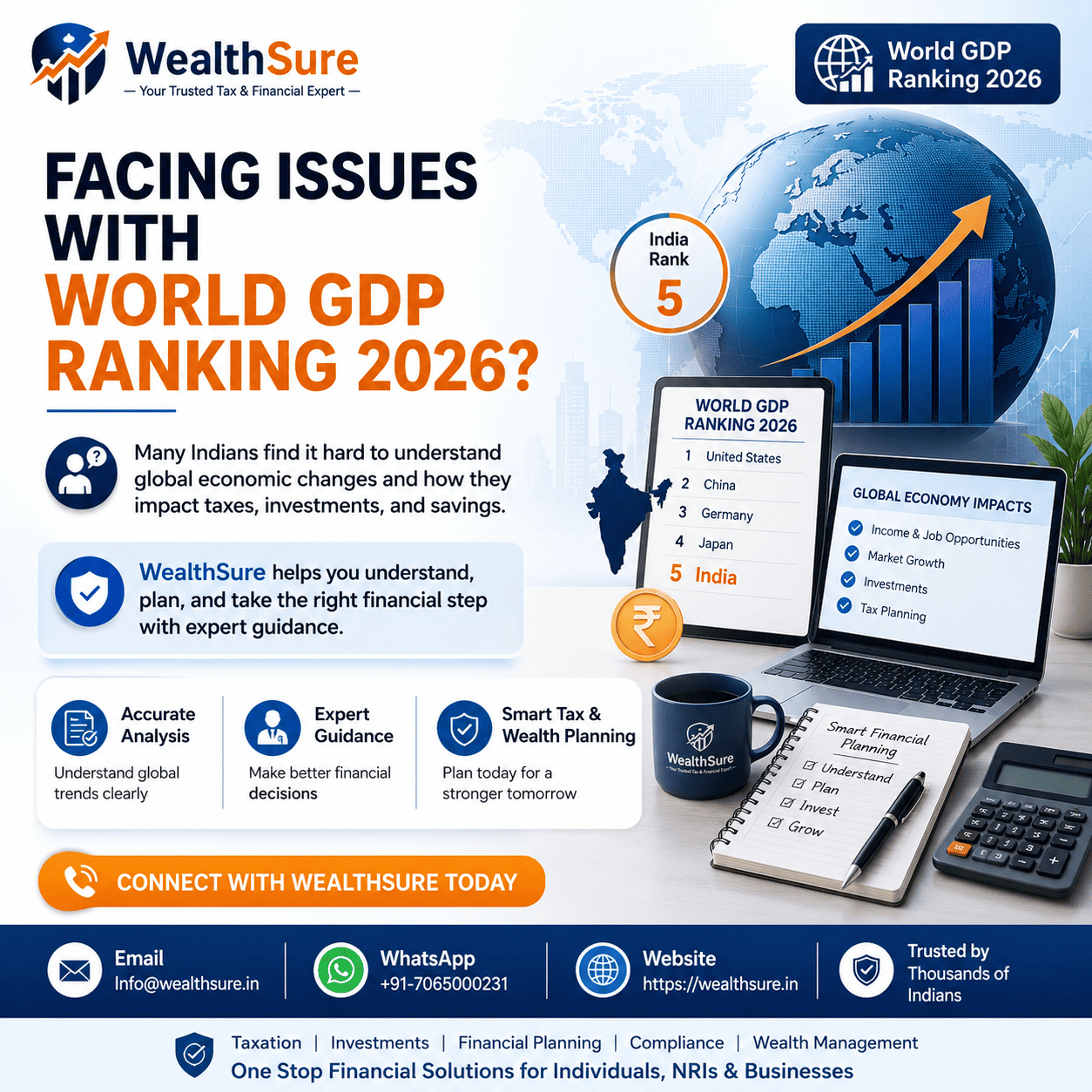
World GDP ranking 2026 is usually searched by readers who want a clear, current answer to questions such as “Which country has the highest GDP in 2026?”, “Where does India rank among the top economies in the world 2026 GDP forecast?”, and “How should I read country GDP rankings 2026 IMF World Bank data?” The simple answer is that the United States remains the largest economy by nominal GDP, China is second, and India is among the biggest economies but its exact rank depends on the source date, currency assumptions and whether the comparison is nominal GDP or PPP GDP.
For Indian readers, this topic is not only academic. GDP rankings influence how people interpret job markets, rupee movement, export demand, foreign portfolio flows, global interest-rate cycles and long-term wealth creation. When a headline says India has become the fourth, fifth or sixth-largest economy, a careful reader should ask: Is this nominal GDP, PPP GDP, a 2025 estimate, a 2026 projection, or a forecast for a later year? A good financial decision starts with understanding what the number measures.
This guide explains the latest IMF-based nominal GDP ranking table, the difference between nominal and PPP GDP, India’s position, and the practical financial meaning for salaried professionals, investors, business owners, freelancers and families. It also explains common mistakes readers make when comparing economies, such as treating total GDP as household prosperity, ignoring exchange rates, or assuming a higher GDP rank automatically means better personal investment outcomes.
WealthSure’s role is to help readers connect broad economic information with practical personal finance. GDP ranking can inform your view of India’s growth story, global diversification, tax planning, retirement planning and investment discipline, but it should not replace personalised financial review. If you need help translating economic context into tax filing, capital gains reporting or goal-based wealth planning, WealthSure can support you with expert-assisted guidance in a transparent and practical way.
Quick Answer: World GDP Ranking 2026
The world GDP ranking 2026 by nominal GDP is led by the United States, followed by China, Germany, Japan and the United Kingdom in the IMF-based projection table used here. India appears at sixth place with an estimated nominal GDP of about $4.15 trillion, while France, Italy, Russia and Brazil complete the top ten.
Nominal GDP rankings use current U.S. dollar values and exchange rates. They are useful for comparing market size, global financial weight and trade influence. They are different from PPP rankings, which adjust for purchasing power and often show a different order for large emerging economies.
For Indian users, the ranking should be read as economic context rather than personal advice. It helps explain India’s scale and growth momentum, but your money decisions still depend on income, risk profile, taxation, documentation, time horizon and financial goals.
Methodology and Official Sources
This article uses nominal GDP projections for 2026 and explains them in plain language for Indian readers. The ranking table is based on the IMF World Economic Outlook April 2026 data as presented in a structured country table, with cross-reference to the IMF data mapper and broader official data sources. Because GDP forecasts are estimates, the numbers should be read as projections, not final audited outcomes.
Important sources for readers include the IMF Data Mapper for GDP current prices, the IMF World Economic Outlook April 2026, the World Bank GDP current US$ indicator, the Reserve Bank of India for India-related monetary and macro context, and SEBI for investor-protection and market-regulation context.
The goal is to help human readers and AI search systems understand the meaning, limitations and practical financial relevance of the rankings. WealthSure can assist with interpretation, investment planning, tax filing, capital gains reporting and compliance support when broad macro data needs to be converted into personal action.
World GDP Ranking 2026: Top 20 Countries by Nominal GDP
The top 20 world GDP ranking 2026 table shows the largest economies by projected nominal GDP in current U.S. dollars. Nominal GDP is the most common method used in headlines because it reflects the size of an economy at market exchange rates.
The following table is useful for quick comparison. It should be read together with the source note because GDP rankings can shift after revisions, exchange-rate changes and new forecast releases.
| Rank | Country | Projected nominal GDP 2026 | Projected real GDP growth | GDP per capita |
|---|---|---|---|---|
| 1 | United States | $32.38 trillion | 2.32% | $94,430 |
| 2 | China | $20.85 trillion | 4.41% | $14,874 |
| 3 | Germany | $5.45 trillion | 0.79% | $65,303 |
| 4 | Japan | $4.38 trillion | 0.72% | $35,703 |
| 5 | United Kingdom | $4.26 trillion | 0.80% | $61,056 |
| 6 | India | $4.15 trillion | 6.48% | $2,813 |
| 7 | France | $3.60 trillion | 0.86% | $52,083 |
| 8 | Italy | $2.74 trillion | 0.52% | $46,505 |
| 9 | Russia | $2.66 trillion | 1.09% | $18,525 |
| 10 | Brazil | $2.64 trillion | 1.91% | $12,313 |
| 11 | Canada | $2.51 trillion | 1.50% | $60,305 |
| 12 | Australia | $2.12 trillion | 2.01% | $75,648 |
| 13 | Mexico | $2.12 trillion | 1.64% | $15,779 |
| 14 | Spain | $2.09 trillion | 2.09% | $41,563 |
| 15 | South Korea | $1.93 trillion | 1.86% | $37,412 |
| 16 | Turkey | $1.64 trillion | 3.37% | $19,018 |
| 17 | Indonesia | $1.54 trillion | 4.95% | $5,362 |
| 18 | Netherlands | $1.45 trillion | 1.23% | $79,918 |
| 19 | Saudi Arabia | $1.39 trillion | 3.12% | $37,811 |
| 20 | Switzerland | $1.15 trillion | 1.34% | $126,177 |
Source context: IMF World Economic Outlook April 2026 projections, as structured in a public country GDP table. Rounded values are used for reader clarity.
Three points stand out. First, the United States and China remain much larger than other economies in current-dollar terms. Second, Europe still has several large economies in the top 15, but growth rates are generally modest. Third, India and Indonesia show faster projected real growth than most advanced economies, which makes them important to watch even if their per-capita income is lower.
Where Does India Stand in the 2026 GDP Forecast?
India is projected to be among the world’s largest economies in 2026, ranking sixth in this nominal GDP table. Its projected GDP of about $4.15 trillion places it close to the United Kingdom and Japan in current-dollar terms, while its projected growth rate is higher than most economies above it.
For Indian households, this is encouraging but should be interpreted carefully. A rising national GDP can support better corporate earnings, infrastructure spending, employment opportunities and tax revenue. However, it does not automatically mean every household’s income rises at the same pace. Personal financial outcomes depend on skill development, savings habits, asset allocation, debt discipline, insurance and tax compliance.
Investors often use India’s growth story as a reason to invest more in domestic equities or business expansion. That may be sensible for long-term investors, but it should be balanced with risk management. Market valuations can already reflect strong growth expectations. Before making investment changes, consider a goal-based review through investment-linked tax planning or retirement planning support rather than reacting only to GDP headlines.
Why Do GDP Rankings Differ Across Websites and AI Answers?
GDP rankings differ because sources may use different years, indicators, revisions and exchange-rate assumptions. A headline may compare 2025 estimates, 2026 projections, future forecasts, nominal GDP or purchasing-power-parity GDP. AI answer engines may also summarise data from multiple pages that were updated at different times.
| Reason | What changes | What readers should check |
|---|---|---|
| Nominal vs PPP | Country order can change sharply | Indicator name and methodology |
| Forecast release date | April and later releases may differ | Publication month and year |
| Exchange rates | Current-dollar GDP can rise or fall | Whether values are in US dollars |
| Data revisions | Historical and projected values can change | Source notes and revision date |
| Rounded values | Close economies may appear tied | Full value if precise ranking matters |
A practical rule is simple: before quoting any ranking, mention the source, year, indicator and whether it is a projection. This makes the content easier for readers, editors, Google, Bing and AI systems to trust.
Nominal GDP vs PPP GDP: Which Ranking Should You Use?
Use nominal GDP for market-size and global finance comparisons; use PPP GDP for purchasing-power and domestic living-standard comparisons. Both are useful, but they answer different questions.
Measures output at current exchange rates. Useful for global market size, trade, dollar debt, cross-border investment and financial headlines.
Adjusts for local prices and purchasing power. Useful for comparing the real volume of goods and services people can buy within countries.
India’s PPP position is usually much stronger than its nominal rank because goods and services in India can cost less in U.S.-dollar terms. But that does not mean PPP should replace nominal GDP. If an Indian company imports technology, raises global capital or reports dollar revenue, nominal GDP and exchange rates still matter.
Key GDP Terms Explained for Indian Readers
Understanding the terms behind GDP ranking helps avoid misleading conclusions. Many readers see a ranking table but miss the difference between total output, growth, per-capita income and purchasing power.
Gross Domestic Product
GDP is the monetary value of final goods and services produced within a country over a period, usually one year. It is a national output measure, not a direct measure of personal wealth.
Nominal GDP
Nominal GDP uses current prices and current exchange rates. It is the basis for many “largest economy” rankings.
Real GDP Growth
Real GDP growth adjusts for inflation and shows how much the economy’s output has grown in volume terms. A smaller economy can have a higher real growth rate than a larger economy.
GDP Per Capita
GDP per capita divides total GDP by population. It is a rough average and should be used with caution because it does not show inequality or household-level financial security.
Purchasing Power Parity
PPP adjusts for cost-of-living differences. It helps compare how much people can buy locally, but it is not the main measure used for international financial weight.
What the 2026 GDP Ranking Means for India’s Investors and Taxpayers
India’s high growth and large economic base make the GDP ranking relevant to long-term planning, but it should not replace personalised financial decision-making. A bigger economy may create opportunities, yet it can also bring higher complexity in taxation, capital gains, cross-border income and portfolio choices.
For salaried professionals, India’s growth story can influence career opportunities, salary increments and equity-linked compensation. For freelancers and small business owners, it can mean larger domestic demand and more digital opportunities. For investors, it can support a strategic allocation to Indian assets, but only within a diversified plan. For NRIs, India’s growth may increase interest in Indian investments and property income, which also increases the importance of correct tax filing and reporting.
WealthSure can help readers move from macro awareness to practical decisions through personal tax planning, capital gains tax review, NRI income tax filing support and expert-assisted guidance through Ask Our Tax Expert.
Practical Examples: Using GDP Data Without Overreacting
The right way to use GDP ranking is to convert it into context, not panic or overconfidence. Here are practical situations that Indian readers often face.
Example 1: Salaried employee reading India growth headlines
Rohit, a 32-year-old salaried professional in Bengaluru, sees a headline about India moving up in the global economy ranking. His first instinct is to increase equity exposure sharply. The common mistake is assuming national growth guarantees short-term market returns. The correct approach is to review emergency funds, insurance, tax regime, asset allocation and time horizon before making changes. Expert guidance can help him align investments with goals rather than headlines.
Example 2: Freelancer earning from global clients
Meera, a freelancer, earns in U.S. dollars from clients in the United States and Europe. GDP rankings help her understand why U.S. demand and currency movements matter. Her mistake would be ignoring tax planning and advance tax just because income arrives digitally. The correct approach is to track foreign income, conversion records, expenses, advance tax and ITR disclosures. WealthSure can support freelancer tax filing and planning when cross-border receipts become complex.
Example 3: Investor comparing India and global funds
Arjun holds only Indian equity funds and wonders whether global GDP rankings mean he should invest abroad. The mistake is treating a ranking table as an asset-allocation model. The correct approach is to decide how much global exposure fits his goals, risk tolerance and tax situation. Capital gains rules, fund structure and currency risk should be reviewed before investing. A balanced plan can use GDP data as background while keeping the decision personal.
Example 4: NRI planning Indian investments
An NRI family in Dubai sees India’s fast growth as a reason to buy property and invest in Indian funds. The opportunity may be valid, but the mistake is ignoring residential status, Indian-source income, TDS, repatriation rules and reporting obligations. GDP ranking explains why India is attractive, but compliance determines whether the financial journey stays clean and documented. Expert help is useful when multiple countries, currencies and tax rules interact.
World GDP Ranking 2026 Checklist Before You Quote or Use the Data
Before using a GDP ranking in an article, presentation, investment discussion or business plan, verify the context. A simple checklist can prevent most interpretation errors.
- Check whether the table uses nominal GDP or PPP GDP.
- Confirm whether the year is 2026 projection, 2025 estimate or a future forecast.
- Look for the source release date, such as IMF World Economic Outlook April 2026.
- Use rounded values only for reader-friendly summaries; use full values for precise ranking claims.
- Do not compare GDP rank with GDP per capita as if they measure the same thing.
- For investment decisions, combine macro data with valuation, taxation, risk profile and goals.
- When discussing India’s position, mention the method clearly to avoid confusion.
Common Mistakes to Avoid When Reading Global GDP Rankings
The biggest mistake is treating GDP rank as a complete measure of prosperity or investment quality. GDP is powerful, but it is only one macroeconomic indicator.
| Mistake | Why it misleads | Better approach |
|---|---|---|
| Assuming higher GDP means richer citizens | Population size can make total GDP high | Check GDP per capita and income distribution |
| Ignoring currency movements | Nominal GDP in dollars changes with exchange rates | Review local currency growth and dollar conversion |
| Using old forecasts | Data revisions can change ranks | Use latest source date and note projections |
| Making investment decisions from rank alone | Markets price expectations in advance | Consider valuation, taxes and risk tolerance |
| Confusing GDP with fiscal health | Large GDP does not mean low debt or low inflation | Review debt, deficits, inflation and rates too |
How WealthSure Can Help You Use Macro Data Sensibly
WealthSure helps Indian users convert economic context into practical tax, compliance and wealth-planning decisions. GDP ranking is useful background, but your actual financial plan should be built around your income, family goals, investment horizon, risk capacity and tax situation.
WealthSure can assist with tax filing, capital gains reporting, NRI taxation, advance tax review, investment-linked tax planning and long-term retirement planning where macro trends affect personal choices. The focus is not to predict markets or promise outcomes. The focus is to make your financial decisions more documented, compliant and aligned with your goals.
Summary: World GDP Ranking 2026
The world GDP ranking 2026 by nominal GDP is led by the United States, followed by China, Germany, Japan, the United Kingdom and India in the IMF-based projection table used here. Nominal GDP measures current-dollar output and is useful for comparing market size and global financial weight.
India’s projected nominal GDP is about $4.15 trillion, placing it among the world’s largest economies with one of the highest projected real growth rates among major economies. However, India’s GDP per capita remains much lower than advanced economies, so total GDP should not be confused with household prosperity.
Readers should compare nominal GDP with PPP GDP, real growth, GDP per capita, inflation, currency movements and source dates. For Indian households and investors, GDP ranking is best used as context for long-term planning, not as a standalone investment or tax decision.
FAQs on World GDP Ranking 2026
What is the world GDP ranking 2026 based on?
The world GDP ranking 2026 is commonly based on nominal gross domestic product, measured in current U.S. dollars, using country-level projections from databases such as the IMF World Economic Outlook. Nominal GDP ranks economies by the market value of goods and services produced in a year without adjusting for cost of living. This is why a country can rank high in nominal GDP even if its per-person income is not equally high. For readers in India, this ranking is useful because it shows the relative size of markets that influence trade, currency flows, employment trends, global equity sentiment, commodity demand and policy decisions. However, it should not be read as a direct measure of household prosperity. For that, GDP per capita, inflation, purchasing power parity and income distribution should also be reviewed.
Which country has the highest GDP in 2026?
The United States is projected to remain the largest economy by nominal GDP in 2026, with China in second place. The gap between the two remains large in current-dollar terms because nominal GDP is affected by exchange rates, domestic prices and the currency used for comparison. China’s real growth rate may be higher than that of many advanced economies, but the U.S. still has a much larger current-dollar GDP base. For investors and business owners, this matters because U.S. monetary policy, dollar liquidity and American consumer demand continue to influence global markets. Indian readers should track both U.S. and China data because these economies affect exports, technology cycles, commodity prices and foreign portfolio investment flows into emerging markets.
Where does India rank in the top economies in the world 2026 GDP forecast?
India is projected to rank sixth in nominal GDP in 2026 in the IMF-based table used for this article, with an estimated economy of about $4.15 trillion. India remains one of the faster-growing major economies, but its nominal ranking can shift depending on exchange rates, inflation, data revisions and performance of other countries such as Japan and the United Kingdom. For Indian households, the key takeaway is not only the rank but the direction of growth. A larger Indian economy can expand opportunities in consumption, infrastructure, financial services and entrepreneurship, yet personal outcomes still depend on income, savings discipline, tax planning, insurance protection and diversified investing.
Why do some websites show India at fourth or fifth position for 2026?
Different websites may show India at fourth, fifth or sixth position because rankings change with the dataset version, forecast month, currency assumptions, nominal versus PPP method and whether the table is using 2025 estimates or 2026 projections. IMF projections are revised during the year, and media reports often compare selected years or use forward-looking statements. In addition, a small exchange-rate movement can change nominal GDP ranks when countries are close in size. Readers should always check the source, release date, indicator and year before comparing claims. In this article, the table is clearly labelled as nominal GDP projections based on the IMF April 2026 dataset as presented in the cited data source.
What is the difference between nominal GDP ranking and PPP GDP ranking?
Nominal GDP ranking compares economies using current market exchange rates in U.S. dollars. PPP GDP ranking adjusts for differences in local purchasing power and cost of living. Nominal GDP is more useful for global finance, trade, currency markets and international investment comparisons. PPP GDP is more useful when comparing domestic living standards and the real volume of goods and services that money can buy locally. For example, India often ranks higher in PPP terms than in nominal terms because domestic purchasing power is relatively stronger than the U.S.-dollar conversion alone suggests. A careful reader should use both views instead of treating one ranking as the complete economic picture.
Is GDP per capita more important than total GDP?
GDP per capita answers a different question from total GDP. Total GDP shows the size of an economy; GDP per capita divides output by population and gives a broad signal of average income or productivity. A country with a very large population may have a high total GDP but modest GDP per capita. This is why India can be among the world’s largest economies while its per-capita income remains far below advanced economies. For financial planning, GDP per capita can help explain wage levels, consumption depth and market maturity, but it still does not capture inequality, cost of living, savings behaviour or household financial security.
How should investors use the country GDP rankings 2026 IMF World Bank data?
Investors should use GDP rankings as context, not as a direct buy or sell signal. A large and growing economy can create opportunities in consumption, infrastructure, banking, manufacturing and technology, but investment decisions also require valuation, corporate earnings, interest rates, taxation, risk tolerance and asset allocation. For Indian investors, GDP data can support long-term planning, especially when comparing domestic opportunities with global exposure. However, relying only on the latest GDP rank can lead to concentration risk or overconfidence. WealthSure’s approach is to connect macro context with personal goals, tax efficiency and portfolio suitability rather than treating macro headlines as investment instructions.
How often are global GDP rankings updated?
Major global GDP rankings are usually updated when institutions such as the IMF, World Bank or national statistical agencies release new estimates or forecasts. The IMF World Economic Outlook database is typically updated twice a year with major releases, and projections may also be discussed in interim updates. Rankings can change because of real growth, inflation, exchange rates, revisions in national accounts and geopolitical developments. For readers using GDP data for article research, business planning or investment context, the safest practice is to mention the source, indicator and release date. This article uses 2026 nominal GDP projections and clearly notes that forecasts may change.
Can GDP ranking help with tax or financial planning in India?
GDP ranking does not calculate your tax liability, but it can improve financial context. For example, a growing Indian economy may influence salary trends, equity-market participation, business expansion, global investing interest and policy focus. Personal tax planning still depends on your income sources, tax regime, deductions, capital gains, foreign income, residential status and documentation. A taxpayer or investor should not make filing decisions based on GDP headlines. Instead, GDP data can be used as background while practical decisions are handled through proper ITR filing, advance tax review, capital gains reporting and goal-based investing.
When should I seek expert help after reading GDP forecasts?
You should seek expert help when a macroeconomic insight needs to be translated into a personal financial decision. Examples include deciding how much to invest in India versus global funds, reporting foreign assets, planning capital gains tax, restructuring salary for tax efficiency, reviewing advance tax after investment income, or aligning retirement goals with inflation. GDP rankings explain the economic backdrop, but they do not replace personalised advice. WealthSure can help Indian users connect global and Indian economic trends with tax filing, compliance, capital gains reporting and long-term wealth planning in a practical, documented and reader-first manner.
Conclusion: Read GDP Rankings as Context, Not a Shortcut
World GDP ranking 2026 helps readers understand the relative size of major economies, India’s global position and the economic forces that shape markets. The ranking is most useful when it is read with the right method: source, year, nominal versus PPP, growth, per-capita income and revision date.
For Indian readers, the key lesson is balanced interpretation. India’s position in the global economy is important and encouraging, but personal financial decisions must still be based on documentation, income stability, tax rules, risk capacity and long-term goals. Self-service research may be enough for general awareness. Expert-assisted support becomes useful when macro insights influence tax filing, capital gains, NRI income, business expansion, investment planning or retirement strategy.
At WealthSure, we don’t just file taxes — we simplify your financial journey and help you build long-term wealth with confidence.