
Income Tax Portal, Government of India Login Page: Safe Login Guide for Indian Taxpayers
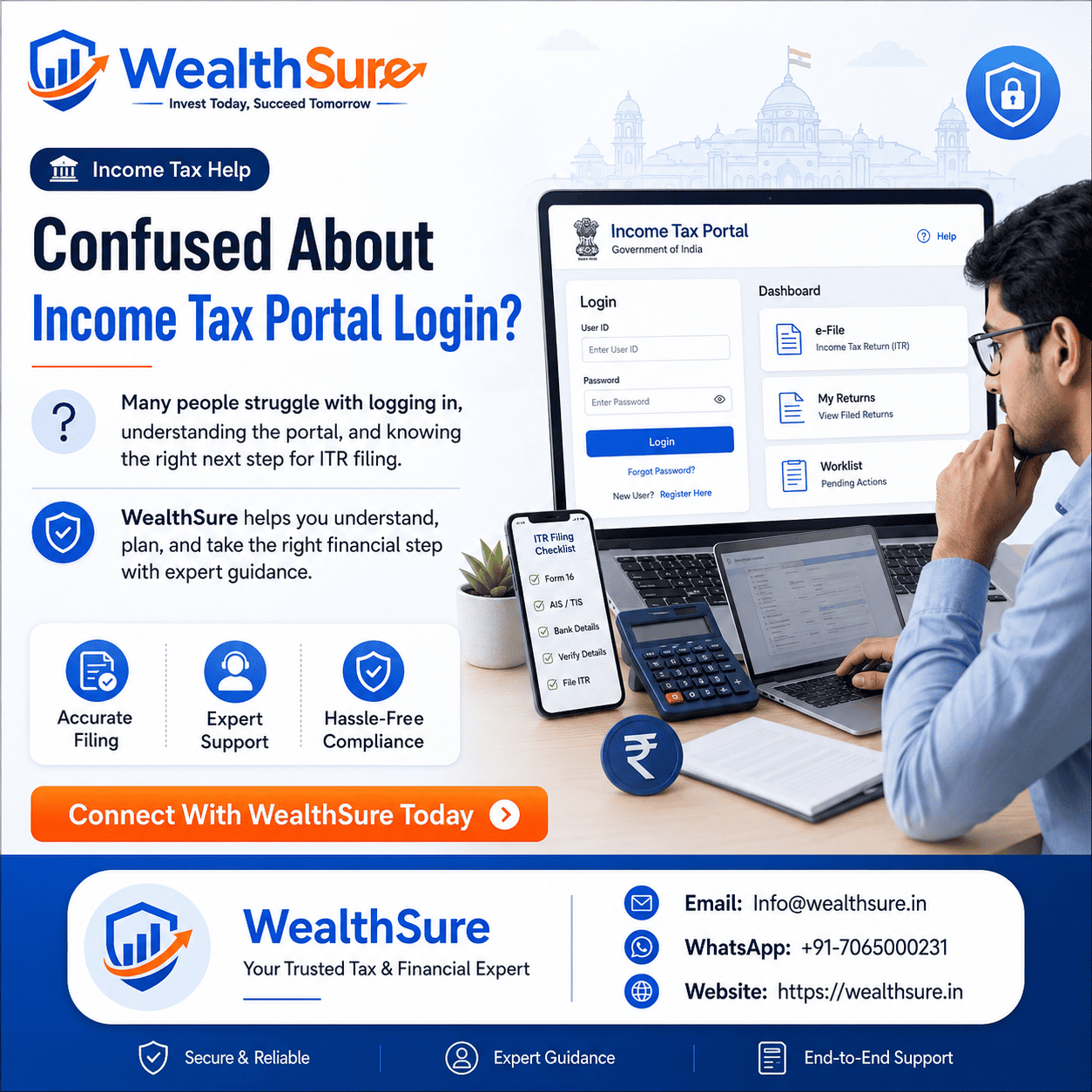
The income tax portal, Government of India login page is the official online gateway through which Indian taxpayers access important tax services such as income tax return filing, e-verification, refund tracking, AIS, TIS, Form 26AS, profile updates, tax notices, pending actions and other compliance-related tasks. For salaried employees, freelancers, professionals, investors, NRIs and business owners, knowing how to log in safely is the first step toward accurate tax compliance.
Many users search for the income tax portal login page during the ITR filing season, after receiving a tax notice, while checking refund status, or when they need to download AIS, Form 26AS or an ITR acknowledgement. The process is usually simple, but small mistakes can create avoidable stress. A taxpayer may use the wrong website, forget the password, enter an incorrect assessment year, ignore pending actions, miss e-verification, or depend only on pre-filled information without reviewing actual income records.
This guide explains how to access the official login page safely, what details you need before logging in, what services are available after login, how to avoid phishing links, what to check before filing your ITR, and when expert assistance may be useful. It is written for Indian taxpayers who want a practical, trustworthy and beginner-friendly explanation without unnecessary technical jargon.
Always use the official Income Tax Department e-Filing portal or the official login service linked from it. Do not enter your PAN, password, Aadhaar OTP, bank details or tax information on unknown links received through email, SMS, WhatsApp or social media.
Access return filing, revised returns, updated returns where applicable, verification and acknowledgement downloads.
View AIS, TIS, Form 26AS, tax credits, refund status and compliance-related information linked to your PAN.
Respond to notices, check pending actions, update profile details, validate bank accounts and track processing.
Table of Contents
- What is the income tax portal Government of India login page?
- Why taxpayers need to log in to the income tax portal
- Details required before login
- How to safely access the official login page
- Step-by-step income tax portal login process
- Important services available after login
- Using the portal for ITR filing and e-verification
- How to access AIS, TIS and Form 26AS after login
- Security tips to avoid fake tax login pages
- Common login problems and solutions
- Taxpayer checklist before using the portal
- When expert support may help
- FAQs on income tax portal Government of India login page
What is the income tax portal Government of India login page?
The income tax portal login page is the secure access point for taxpayers on the Income Tax Department’s e-Filing portal. It allows registered users to access services linked to their PAN, such as income tax return filing, e-verification, refund status, AIS, TIS, Form 26AS, pending actions, notices, profile details, bank validation and tax payment-related information.
In simple terms, the login page is where the taxpayer identity is authenticated before sensitive tax data is displayed. Since tax records contain personal, financial and compliance information, the portal requires user ID, password and verification steps depending on the service or security setting. For most individual taxpayers, the PAN is commonly used as the user ID.
The portal is useful not only during tax filing season but throughout the year. You may need it when your employer asks for a tax acknowledgement, when you want to check whether your refund has been processed, when a bank asks for proof of income, when AIS shows a high-value transaction, when you receive an intimation or notice, or when you want to update your profile and bank account details.
WealthSure Expert Tip
Do not treat the income tax portal as a once-a-year website. Log in periodically to check your profile, bank validation status, pending actions, AIS information and refund status. Early review helps avoid last-minute panic during the ITR filing deadline.
Why taxpayers need to log in to the income tax portal
Taxpayers log in to the income tax portal for different reasons. A salaried employee may want to file ITR using Form 16 and pre-filled data. A freelancer may want to match client TDS with professional receipts. An investor may need to check capital gains, dividends and securities transactions appearing in AIS. An NRI may need to review Indian income and tax credits. A business owner may need to access notices, returns and compliance records.
The login page gives access to tax services that are not available publicly because they are linked to your PAN and personal tax profile. Once logged in, you can review records reported by employers, banks, mutual fund platforms, brokers, deductors and other reporting entities. This helps you file a more accurate return.
| Reason for Login | What You Can Check | Why It Matters |
|---|---|---|
| ITR filing | Assessment year, ITR form, pre-filled income, tax credits and return status | Helps file the return correctly and avoid mismatch |
| Refund tracking | Refund issue status, processing status and bank validation | Helps identify refund delays or bank account issues |
| AIS and TIS review | Reported income, financial transactions and tax information | Helps detect missing income or incorrect reporting |
| Form 26AS review | TDS, TCS and tax payment details | Helps match tax credits before filing |
| Notice response | Pending actions, e-proceedings and communications | Helps respond within required timelines |
| Profile update | Mobile, email, address, bank account and Aadhaar-linked details | Helps receive OTPs, refunds and official updates correctly |
Details required before logging in
Before opening the income tax portal, keep the required details ready. This reduces failed login attempts and helps you complete the task smoothly. The exact verification method may vary depending on your account settings and the service being accessed, but taxpayers generally need basic identity and authentication details.
Basic details usually required
- PAN or user ID registered on the e-Filing portal.
- Password for the income tax e-Filing account.
- Registered mobile number for OTP or verification messages.
- Registered email ID for official communication.
- Aadhaar-linked mobile access if Aadhaar OTP verification is required.
- Bank account or demat account access if EVC-based verification is used.
- Updated browser such as Chrome, Edge, Firefox or Safari.
Documents useful after login
If you are logging in for ITR filing or tax review, keep relevant documents ready. These may include Form 16, salary slips, Form 16A, interest certificates, bank statements, capital gains statements, mutual fund reports, demat statements, rent records, home loan certificates, advance tax challans and details of deductions claimed under the old tax regime.
For freelancers, professionals and business owners, also keep invoices, client TDS details, expense summaries, GST records where applicable, books of account or income and expense statements. For NRIs, keep residential status information, Indian income records, TDS certificates and foreign income or asset details where relevant.
How to safely access the official income tax portal login page
The safest way to access the income tax portal Government of India login page is to visit the official Income Tax Department e-Filing portal directly. Avoid clicking random advertisements, shortened links, forwarded messages or unofficial pages that claim to provide faster refund processing or tax login assistance.
Before entering your user ID or password, check the website address carefully. The official portal should belong to the Income Tax Department, Government of India. Also check that the site uses HTTPS and that the browser does not show a security warning. If the page looks unusual, asks for unnecessary bank passwords, or promises instant refunds, close it immediately.
Important security warning
The Income Tax Department does not ask for PIN numbers, passwords or similar access information for credit cards, banks or other financial accounts through email. Never share OTPs, passwords, Aadhaar OTPs, UPI PINs or financial access details with unknown callers, fake support agents or unofficial tax refund links.
Step-by-step income tax portal login process
The portal design may change from time to time, but the broad login flow remains similar. Use the steps below as a practical guide and follow the current instructions visible on the official portal.
Simple login flow
Use the official portal, enter your user ID, verify secure access details, enter your password and complete any required authentication.
Visit the official Income Tax Department e-Filing portal directly from your browser.
Select the login option and enter your PAN or registered user ID.
Review the secure access message or verification prompt before entering your password.
After successful login, review dashboard alerts, pending actions and required services.
Step 1: Visit the official Income Tax e-Filing portal
Open the official Income Tax Department e-Filing portal. It is better to type the website address directly into the browser instead of relying on links from unknown sources. Bookmark the official portal once you confirm it.
Step 2: Click the login button
On the portal homepage, click the login option. The portal will ask for your user ID. For many individual taxpayers, the PAN works as the user ID. Enter it carefully and continue.
Step 3: Check the secure access message
The portal may show a secure access message or a confirmation step before the password field. A personalized secure access message is a useful way to check that the website where you are entering your user ID and password is the genuine e-Filing portal.
Step 4: Enter password and complete verification
Enter your password and complete the required authentication. Depending on your account settings, the portal may ask for OTP, EVC, Aadhaar-based verification or other security steps. Use only your registered mobile, registered email, validated bank account or other official verification method.
Step 5: Review dashboard after login
After successful login, do not go directly to one task without reviewing the dashboard. Check pending actions, profile alerts, e-proceedings, refund status, return filing status and bank account validation. These dashboard items can help you identify important issues before filing or responding to tax communications.
Important services available after login
The income tax portal is not limited to ITR submission. It is a taxpayer dashboard that brings together several important compliance services. The exact menu labels may change, but the following services are commonly relevant for individuals, freelancers, professionals, investors, NRIs and businesses.
| Portal Service | What It Helps You Do | Useful For |
|---|---|---|
| File Income Tax Return | Prepare, submit and verify ITR for the applicable assessment year | Salaried taxpayers, freelancers, investors, NRIs and businesses |
| View Filed Returns | Download acknowledgement, check filing history and track status | Loan applications, visa documentation and compliance records |
| e-Verify Return | Complete verification of a submitted return | Taxpayers who selected verify later or filed through assistance |
| AIS and TIS | Review taxpayer information and reported transactions | Taxpayers checking income, dividends, interest and transactions |
| Form 26AS | Review TDS, TCS and tax payment records | Taxpayers matching tax credits before filing |
| Refund Status | Track whether refund is processed, issued or delayed | Taxpayers expecting refund after ITR filing |
| e-Proceedings | View and respond to notices or proceedings | Taxpayers who receive notices, intimations or compliance queries |
| Profile and Bank Details | Update contact details and validate refund bank account | All registered taxpayers |
Using the income tax portal for ITR filing and e-verification
One of the most common reasons people search for the income tax portal Government of India login page is to file their income tax return. After login, the taxpayer can access return filing services, choose the relevant assessment year, select the filing mode, choose the applicable ITR form and review pre-filled information.
Pre-filled data can be helpful, but it should not be treated as automatically final. You are responsible for reporting income correctly. Always compare portal data with your actual records, such as Form 16, salary slips, bank interest certificates, AIS, TIS, Form 26AS, capital gains statements, rent details, professional receipts and tax challans.
Key checks before submitting ITR
- Confirm the correct assessment year.
- Select the correct ITR form based on your income sources.
- Check whether old or new tax regime gives the correct result for your case.
- Verify salary, house property income, capital gains, business income and other income.
- Match TDS, TCS, advance tax and self-assessment tax with records.
- Confirm deduction claims with proof, especially under the old tax regime.
- Validate bank account details for refund.
- Preview the full return before final submission.
- Complete e-verification after filing.
After filing, e-verification is essential. Submission alone does not complete the process. The official e-Verify service allows taxpayers to e-verify income tax returns and other income-tax-related submissions through available verification modes on the e-Filing portal. The department’s taxpayer messages and guidance continue to highlight a 30-day verification window after return filing.
Filing ITR after logging in? WealthSure can help you review AIS, Form 26AS, income sources, deductions, tax regime and e-verification before submission.
Explore WealthSure ITR filing servicesHow to access AIS, TIS and Form 26AS after login
AIS, TIS and Form 26AS are among the most important records to check after logging in to the income tax portal. These statements help you understand what information is available to the tax department and whether it matches your actual records.
What is AIS?
AIS stands for Annual Information Statement. The official portal guides taxpayers to log in, go to the e-File menu, select Income Tax Return and then View AIS to access the AIS portal. AIS may include items such as interest, dividends, securities transactions, tax deducted, tax collected and other reportable information. Taxpayers can also provide feedback on reported information where required.
What is TIS?
TIS stands for Taxpayer Information Summary. It is a summarized view based on AIS information. It helps taxpayers review broad categories of information before filing. However, TIS should be compared with actual documents rather than accepted blindly.
What is Form 26AS?
Form 26AS is useful for reviewing tax credits such as TDS, TCS and tax payments linked to your PAN. Before filing ITR, match Form 26AS with Form 16, Form 16A, challans and other tax credit records. If there is a mismatch, identify the reason before submission where possible.
| Statement | Information It Helps Review | Practical Action |
|---|---|---|
| AIS | Reported income, transactions, tax information and feedback items | Check whether reported information matches your actual records |
| TIS | Summarized taxpayer information based on AIS | Use it as a summary, not as a replacement for documents |
| Form 26AS | TDS, TCS and tax payment records | Match tax credits before claiming refund or submitting ITR |
Security tips to avoid fake income tax login pages
Taxpayers should be especially careful during ITR filing season because fake refund messages, phishing emails and fraudulent login pages often target people who are expecting tax refunds or trying to file returns quickly. A fake page may look similar to the official portal but may be designed to collect PAN, password, OTP, Aadhaar details or bank credentials.
Follow these safe login practices
- Type the official portal address directly into your browser.
- Check the website address before entering any login information.
- Do not click shortened links claiming to offer instant refund or tax approval.
- Never share OTP, password, Aadhaar OTP, UPI PIN, card PIN or bank password.
- Use a strong password and do not reuse it on other websites.
- Keep your registered mobile number and email secure.
- Log out after completing your work, especially on shared devices.
- Avoid using public Wi-Fi for tax filing or financial tasks.
- Do not download unknown files sent in the name of tax refund or notice.
- Use official helpline or trusted professional support for complex issues.
Red flags of a fake tax login page
Be cautious if a page asks for your full debit card details, net banking password, UPI PIN, remote screen-sharing access, or payment to “release” a refund. Refund processing is linked to return processing and validated bank details, not to sharing sensitive banking credentials with anyone.
Common income tax portal login problems and solutions
Login issues are common, especially during peak filing periods. Some problems are technical, while others are due to outdated contact details, forgotten passwords or browser settings. Do not panic if login fails once. Check the issue carefully and use the official recovery options available on the portal.
| Problem | Possible Reason | Suggested Action |
|---|---|---|
| Forgot password | Password not remembered or changed earlier | Use the official forgot password option and complete verification |
| OTP not received | Wrong registered mobile, network issue or delay | Check registered contact details and retry after a reasonable gap |
| Account locked | Multiple incorrect login attempts | Wait as per portal instructions or use official recovery steps |
| Page not loading | Browser issue, cache problem or heavy portal traffic | Use an updated browser, clear cache or try again through official portal |
| Bank validation failed | Name mismatch, incorrect account details or inactive account | Update bank details and validate the account before refund processing |
| Unable to e-verify | OTP, EVC, Aadhaar or bank validation issue | Try another available verification method or seek support before deadline |
| Mismatch in AIS or Form 26AS | Deductor reporting issue, duplicate entry or timing difference | Compare documents and provide feedback or seek correction where needed |
Taxpayer checklist before using the income tax portal
A simple checklist can help you avoid mistakes when using the portal for ITR filing, refund tracking or tax record review. This is especially useful for first-time users and taxpayers with multiple income sources.
| Checklist Item | Completed? | Why It Matters |
|---|---|---|
| Official website verified | Yes / No | Protects you from phishing and fake login pages |
| PAN or user ID ready | Yes / No | Helps complete login without errors |
| Registered mobile and email accessible | Yes / No | Needed for OTPs and official communication |
| Profile details checked | Yes / No | Prevents communication and identity issues |
| Bank account validated | Yes / No | Important for refund credit |
| AIS and TIS reviewed | Yes / No | Helps identify reported income and transactions |
| Form 26AS checked | Yes / No | Helps verify TDS, TCS and tax payments |
| Correct assessment year selected | Yes / No | Avoids filing or checking the wrong year |
| ITR e-verification completed | Yes / No | Completes the return filing process |
Income tax portal login guide for different taxpayer profiles
For salaried employees
Salaried taxpayers usually log in to file ITR, check Form 16 details against portal data, review AIS, verify Form 26AS, select the correct tax regime and claim eligible deductions. If you changed jobs during the year, make sure income from both employers is included. Do not assume that employer TDS automatically means your ITR is complete.
For freelancers and professionals
Freelancers and professionals should use the portal to check TDS deducted by clients, review AIS entries, confirm advance tax payments and prepare business or professional income reporting. If you receive income from multiple clients, maintain invoice-wise and bank-wise records before filing.
For investors
Investors should log in to review AIS, dividends, securities transactions and tax credit information. However, AIS is not a replacement for proper capital gains statements. Use broker reports, mutual fund capital gains reports and transaction records to calculate gains accurately.
For NRIs
NRIs should be careful while using the portal because residential status, Indian income, DTAA considerations, TDS on Indian income and foreign asset reporting may affect the return. Do not file using a simple form without reviewing eligibility and disclosure requirements.
For small business owners
Small business owners may use the portal for ITR filing, tax payment records, notices, pending actions and compliance tracking. Business returns may require more detailed reporting than salary returns, so maintain books, GST records where applicable, bank statements and expense records before filing.
When should you take expert help?
Many simple portal tasks can be handled by taxpayers themselves. However, professional support becomes valuable when the login task leads to a complex tax decision. For example, checking refund status is simple, but resolving a refund mismatch may require document review. Downloading AIS is simple, but explaining high-value or duplicate entries may need expert analysis. Filing a basic salary return may be manageable, but filing with capital gains, foreign income or business income can be complex.
Consider expert assistance if you have:
- Income from more than one employer.
- Freelance, consulting, professional or business income.
- Capital gains from shares, mutual funds, property or other assets.
- NRI taxation questions or residential status confusion.
- Foreign income or foreign assets.
- Crypto or virtual digital asset reporting.
- A large refund claim or refund delay.
- Mismatch in AIS, TIS, Form 26AS or TDS records.
- An income tax notice, defective return or intimation mismatch.
- Confusion about old tax regime vs new tax regime.
- Need to file a revised return, belated return or updated return where applicable.
Need help after logging in to the income tax portal? WealthSure can assist with ITR filing, tax regime comparison, AIS/Form 26AS review, capital gains reporting, notice response, NRI taxation and expert-led tax planning.
Ask a WealthSure tax expertFAQs on income tax portal, Government of India login page
1. What is the income tax portal Government of India login page?
It is the official login gateway on the Income Tax Department e-Filing portal where taxpayers can access services such as ITR filing, e-verification, AIS, TIS, Form 26AS, refund status, profile updates, notices and pending actions.
2. What is the official website for income tax portal login?
You should use the official Income Tax Department e-Filing portal at https://www.incometax.gov.in/iec/foportal/ or the official login service linked from the portal. Avoid unknown links and fake refund pages.
3. Can I use PAN to log in to the income tax portal?
For many individual taxpayers, PAN is used as the user ID for login. Follow the current login instructions visible on the official portal and ensure your PAN is entered correctly.
4. What can I do after logging in to the income tax portal?
After login, you can file ITR, verify returns, view filed returns, check refund status, access AIS, TIS and Form 26AS, update profile details, validate bank accounts, check notices and respond to pending actions.
5. Is the income tax portal login page safe?
It is safe when you use the official Government of India Income Tax Department portal, verify the website address, avoid suspicious links, do not share OTPs or passwords and log out after completing your work.
6. I forgot my income tax portal password. What should I do?
Use the official forgot password option available on the portal. Complete the required verification through official methods. Do not ask unknown third parties to reset your password or share your OTP with anyone.
7. Why should I check AIS after logging in?
AIS shows information reported to the tax department for a taxpayer, such as income and transaction details. Checking AIS before filing helps identify missing income, incorrect reporting, duplicate entries or information that may need feedback.
8. What is the difference between AIS and Form 26AS?
AIS provides a broader view of taxpayer information and reported transactions, while Form 26AS is especially useful for reviewing TDS, TCS and tax payment records. Both should be checked before filing ITR.
9. Can I check my refund status after login?
Yes. Taxpayers can check return processing and refund-related status through the income tax portal. Make sure your return is verified and your bank account is validated for refund credit.
10. What happens if I file ITR but do not e-verify it?
E-verification is required after submitting the return. Taxpayers should complete verification within the applicable portal timeline. If verification is not completed properly, the return may not be treated as valid in the intended manner.
11. Can WealthSure help me use the income tax portal?
Yes. WealthSure can help with expert-assisted ITR filing, AIS and Form 26AS review, tax regime comparison, capital gains reporting, NRI taxation, notice response, revised returns, updated returns and tax planning support.
12. Should I give my income tax portal password to a tax filing service?
You should be careful with login credentials and work only with trusted, compliant providers. Prefer secure, transparent workflows and never share OTPs or sensitive banking credentials through informal channels.
Conclusion
The income tax portal, Government of India login page is an essential gateway for Indian taxpayers. It helps you file returns, verify ITR, check refunds, review AIS, access Form 26AS, update profile information, respond to notices and manage tax compliance online. But safe login practices and accurate review are just as important as portal access.
Before logging in, verify the official website, keep your PAN and registered contact details ready, avoid suspicious links and protect your OTPs and passwords. After login, check your dashboard, profile, bank validation, AIS, TIS, Form 26AS and return status carefully. If your tax situation includes multiple income sources, capital gains, business income, professional receipts, foreign assets, NRI issues, notices or refund mismatch, consider expert guidance before taking action.
Make tax compliance simpler with WealthSure. From ITR filing and tax planning to AIS review, notice response, capital gains reporting and NRI taxation, WealthSure helps you manage taxes with confidence.
Get started with WealthSureDisclaimer
This article is for general informational and educational purposes only. It does not constitute tax, legal, financial or professional advice. Income tax rules, return forms, portal features, timelines, verification methods and compliance procedures may change. Please check the official Income Tax Department website or consult a qualified tax professional before filing your return, responding to notices or making tax decisions.